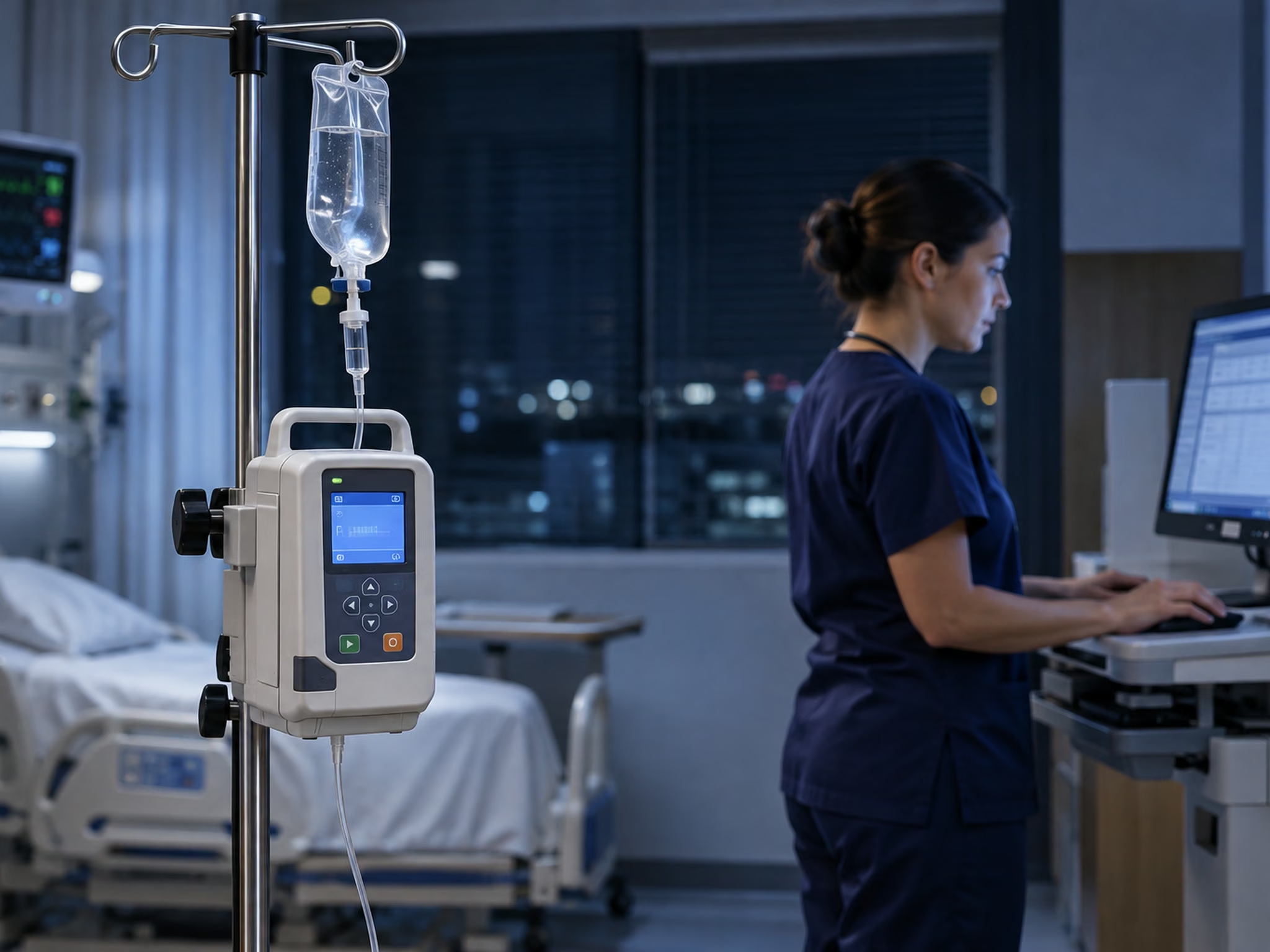
At 2:14 a.m., an unauthorized modification changes executable instructions within the firmware of a network-connected infusion pump on a hospital's medical-surgical floor. No alarm sounds. No dashboard turns red. The nurse making rounds keeps checking readouts that look, for now, entirely normal.
That moment, when an unauthorized change occurs inside a device, can influence how the rest of the story plays out. It's also a moment that security tools monitoring the network or surrounding environment may never see.
The Timeline of a Typical Attack
Many cyberattacks against healthcare environments unfold in stages, and the visible impact may come well after the initial compromise:
- Reconnaissance: Scanning for exposed remote access, unpatched systems, vulnerable devices, or entry points through vendors and contractors.
- Initial compromise: A phishing email, stolen credentials, or an exploitable vulnerability gives an attacker a foothold.
- Persistence: The attacker may establish a means of maintaining access, potentially surviving reboots and routine maintenance.
- Lateral movement and staging: The attacker explores the environment, potentially escalates privileges, and positions for the intended objective. In interconnected healthcare environments, this activity can extend beyond traditional IT systems into operational and clinical technology.
- Execution and impact: Malicious code executes or unauthorized actions occur, potentially resulting in ransomware deployment, disrupted clinical operations, compromised patient information, or manipulation of connected devices.
Not every attack follows this sequence, and some progress rapidly from compromise to impact. But the time between initial access and an attacker's ultimate objective can provide an important opportunity to identify unauthorized activity and limit its consequences.
Why Attackers Focus on Persistence
Initial compromise is often just the beginning. For attackers seeking prolonged access, persistence creates opportunity.
An attacker who maintains access can study the environment, identify critical systems, move between connected assets, and choose when to execute an objective. The longer unauthorized activity goes undetected, the greater the opportunity to expand the scope or impact of an intrusion.
Persistence can take many forms, including compromised credentials, modified configurations, malicious services, and changes to executable code or firmware. Some of these techniques may be visible through conventional security monitoring. Others, particularly unauthorized changes occurring inside embedded or resource-constrained devices, can be difficult to identify from outside the device.
In healthcare environments, that visibility gap matters. Connected medical devices support critical clinical functions, and unauthorized changes to their operation can create risks extending beyond data security to the continuity and safety of patient care.
The Cost of Delayed Detection
Delayed detection can turn a contained security incident into a widespread operational problem.
Healthcare organizations depend on an increasingly interconnected environment of traditional IT systems, clinical applications, medical devices, and supporting infrastructure. Each connection introduces operational benefits, but also potential pathways for cyber threats.
The scale of this exposure is significant. According to Claroty's State of CPS Security: Healthcare Exposures 2025 report, researchers analyzed more than 2.25 million connected medical devices and 647,000 OT devices across 351 healthcare organizations. They found that 99% of organizations studied had devices containing known exploited vulnerabilities, while 89% had medical devices with vulnerabilities linked to ransomware attacks and insecure internet connectivity.
These findings do not mean that those organizations were compromised. They do, however, illustrate the extent of potential exposure within connected healthcare environments, including devices and systems essential to clinical operations.
For healthcare organizations, the consequences of a successful cyberattack can extend well beyond financial losses or compromised data. Disruption to connected medical devices and clinical systems can affect patient care, operational continuity, and the ability of healthcare professionals to deliver essential services.
Traditional security tools provide valuable visibility into network traffic, endpoint behavior, and known indicators of compromise. But many of these approaches rely on observing activity around a device rather than directly verifying the integrity of the executable instructions operating inside it.
A quiet, unauthorized change to a device's firmware or executable code may not immediately produce suspicious network traffic or recognizable malicious behavior.
That creates a critical visibility gap: a device can transition from an approved state to an unauthorized state before conventional security tools recognize evidence of malicious activity.
How Early Detection Changes the Outcome
Now rewind the hospital scenario, this time with a Crytica Probe operating inside that same infusion pump.
At 2:14 a.m., executable instructions within the device's firmware are modified without authorization.
Rather than waiting for suspicious network activity, known malware signatures, or abnormal device behavior, RDAi™ monitors the integrity of the protected device itself.
The Crytica Probe monitors the device's executable instructions, while the Detector compares the monitored state against an established baseline maintained outside the protected device.
Through Deterministic Detection, RDAi identifies when monitored instructions differ from their approved state. This provides direct evidence that a change has occurred, without relying on behavioral inference or a library of known threats.
An unauthorized change does not necessarily mean malicious activity has occurred. But knowing that a monitored change has taken place provides security teams with an important signal to investigate, reducing ambiguity and helping them respond more quickly.
When a change is detected, RDAi generates an alert that can be delivered through the hospital's existing SIEM, XDR, or other security response infrastructure.
The security team gains visibility into the affected device and the detected change, enabling an informed response. Depending on the circumstances, that response may include investigation, remediation, or isolation of the affected device when operationally appropriate.
In a clinical environment, these decisions are especially important. Isolating a medical device must account for patient safety and continuity of care.
That's the difference: rather than relying solely on evidence of malicious behavior or downstream impact, the organization gains visibility into unauthorized changes inside the device itself.
RDAi is designed to identify monitored changes in near real-time and deliver actionable alerts within seconds, helping security teams investigate and respond before an incident has the opportunity to expand.
And with a Probe footprint as small as 100 KB, RDAi is designed to extend this capability into resource-constrained OT, IoT, and embedded environments, complementing the cybersecurity systems organizations already have in place.
The First 60 Seconds Are a Choice
When a device transitions from an approved state to an unauthorized state, the speed at which that change is identified can make a meaningful difference.
Traditional security monitoring remains essential, but it may not provide direct visibility into changes occurring within the executable instructions of a protected device.
Deterministic Detection adds that missing perspective.
By identifying monitored changes in near real-time and delivering alerts through existing security infrastructure, RDAi helps organizations move from discovering potential compromise through its consequences to recognizing evidence of unauthorized change as it occurs.
For healthcare organizations, where operational continuity and patient safety are paramount, that additional visibility can provide critical time to investigate, respond, and potentially prevent a localized incident from becoming something much more serious.
See how RDAi™ detects unauthorized changes to executable instructions in near real-time and supports faster, more informed response decisions. Request a demo to see how it can work in your environment.